As mentioned in the title, it is a Digital Signal Processing stuff, but it can be applied to other fields which need to determine any 2D decision regions... (It sounds shit to laymen...)
Below is a brief lesson for background started from the point of view under signal processing.

Fig 1: Constellation Diagram
During a physical communication, a set of signals called Modulation Scheme is used to indicate information(e.g. '00', '11', '10...) to be transmitted. The signal in a Modulation Scheme can be represented by a set of orthogonal signals called Signal Space. The number of the orthogonal signals is thus the number of dimensions of the signal space. Then, a Modulation Scheme can be represented as a set of point symbol in the Signal Space that is called a Constellation Diagram.

Fig.2: Decision Region
During a transmission, it is normal that the signal will suffer noise from the environment, that represents as a displacement of symbol in the Signal Space. If Noise is high enough, the transmitted symbol may be shifted to a location close to other symbol so that the receiver will de-modulate out wrong symbol. So it is important to keep sufficient distance between each signal symbol pairs in the Modulation Scheme in the signal space if noise is quite high. The distance implies each symbol has its own optimal decision region in the signal space to minimize the Symbol Error Ratio and thus the Bit Error Rate.

Now make a break of the lesson, let me recall the aim of the M-Ary Quadrature Signal Modulation Decision Region Generator(M-Ary QSMDR Generator). The aim of the M-Ary QSMDR Generator is to "Draw Optimal Decision Regions of any number of Signal Symbol in a 2-Dimensional Signal Space".
Below is the brief description of the main project files,
M_Ary_QSMDR_Generator.m: Create Arguments(e.g. Signal Set, Probability Set) for SignalSymbolDecisionRegionGenerator.m
SignalSymbolDecisionRegionGenerator.m: Create and Draw the Decision Regions of the input Signal Symbol.
SignalSymbolDecisionBdry.m: Create Decision Boundary between two signal symbols with given probabilities of the symbols and the Additive White Gaussian Noise(AWGN) .
Based on previous background and description, it's time to explain the algorithm which is implemented in SignalSymbolDecisionRegionGenerator.m.
A. Create Boundary Line between Signal Symbol pair:
- Every Signal Symbol pair are put into SignalSymbolDecisionBdry.m to create its Decision Boundary based on below criteria.

Fig 3. Decision Boundary Criteria

Fig 4: Decision Regions before truncation
At this step, the optimal decision region problem becomes a Geometry problem.
B. Cut unnecessary boundary segment
To be honest, it is not easy to archive this task. Fortunately, I found out this is possible if treat the lines in the constellation diagram as vectors. By comparing the angles between those vectors, it is possible to get which boundary segments are closest to the symbol. Below is the Vector Angle Comparison Criteria.


By above Four criteria, the unnecessary boundary segments is able to be determined, and then truncated on the Decision Region diagram.
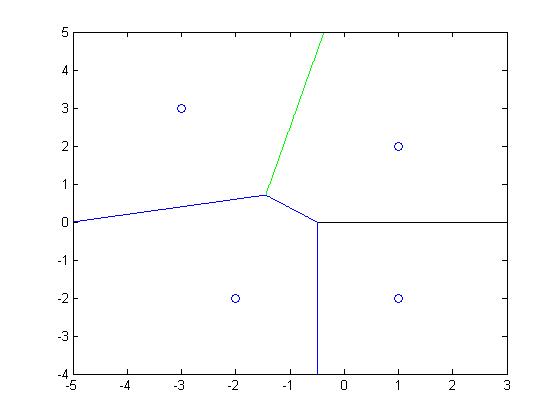
Below are some examples of the Decision Region generated,




Comment:
This stuff is the most difficult project I have ever made before...
The difficulty is on the discovery on the relations between symbols and their intercepted boundary lines...